Category: Uncategorized

  • Keeping Cannabis Fresh in the Package: Humidity, Light, Oxygen, and Heat

    Keeping Cannabis Fresh in the Package: Humidity, Light, Oxygen, and Heat

    A cannabis package has two jobs. The obvious one is compliance and shelf appeal; the quieter one is preservation. Flower is a botanical product, and from the moment it is cured it is under attack from four things: moisture, light, oxygen, and heat. A dispensary can control the temperature, but by the time a jar or bag reaches a customer’s shelf, the packaging is the only defense left standing against the other three. Understanding what each enemy does, and which one your package can actually stop, is the difference between a brand known for fresh, aromatic flower and one quietly known for dry, faded product.

    Humidity lives in a narrow band

    Cannabis wants a relative humidity most people would find surprisingly specific. The industry-referenced target sits at roughly 55 to 65 percent, and laboratory work narrows the sweet spot further, to somewhere around 59 to 63 percent. That band is narrow because both edges are punishing. Drift above about 65 percent and the extra moisture invites mold and mildew, the kind of contamination that fails a compliance test and endangers a consumer. Drop below about 55 percent and the flower dries out, the trichomes turn brittle and harsh, and the volatile oils that carry aroma and effect evaporate away. The chart below shows why the middle is the only comfortable place to be.
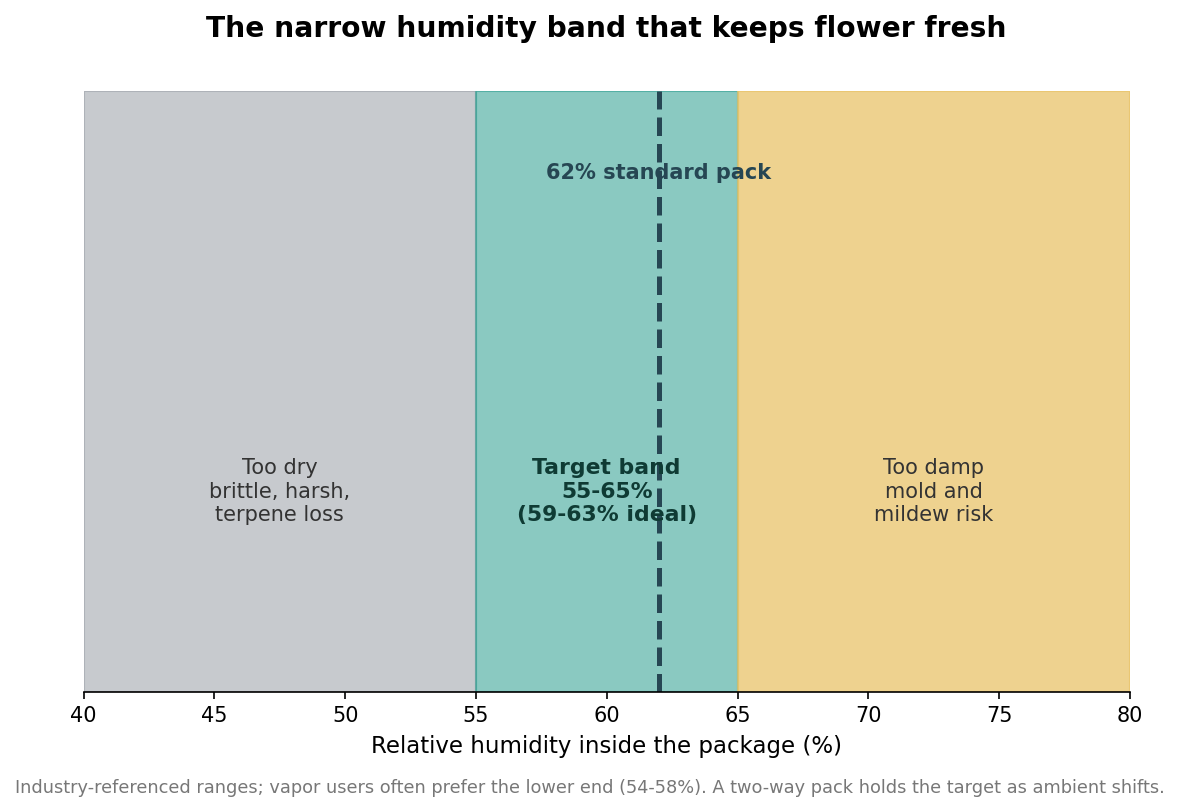
    Horizontal humidity zone chart showing below 55% too dry, 55 to 65% target band with 62% standard pack marked, and above 65% mold risk
    Cannabis flower keeps best in a narrow 55-65% relative humidity band, with a 62% pack the common default.

    The practical tool is a two-way humidity pack, which both releases and absorbs moisture to hold a target as the surrounding air changes. A 62 percent pack is the common default for flower, while people who vaporize their product often prefer a drier 54 to 58 percent. Including the right pack sizes the package to the product rather than leaving humidity to chance, and it is one of the few preservation choices a brand can build directly into what ships.

    Light is the enemy your bag can block

    Of the four threats, light is the one packaging defeats most completely. Ultraviolet and even visible light break down cannabinoids, and a frequently cited study from the 1970s concluded that light was the single largest factor in the loss of cannabinoids from stored cannabis. Sunlight is the worst offender, but fluorescent and other indoor lighting contribute too, which matters for product sitting under retail display lights for weeks. The fix is simply opacity. An opaque or heavily tinted package blocks the light before it ever reaches the flower.

    This is where clear packaging carries a real cost. A transparent jar or window bag shows off the product, but it also lets in exactly the wavelengths that fade it, so the same feature that sells the flower on the shelf degrades it on the shelf. Brands that want visibility can compromise with amber or smoke tints, small windows rather than clear fronts, or an opaque outer that is only opened at purchase. The point is to treat clarity as a deliberate trade, not a free one.

    Oxygen and headspace

    The more oxygen the flower sits in, the faster it oxidizes. Air is why barrier matters. A high-barrier film or a genuinely airtight jar slows the exchange of oxygen and moisture between the flower and the outside world, which is the whole reason metallized mylar and foil laminates dominate the category over thin single-layer plastics. The barrier is not just about keeping smell in; it is about keeping air out, and a resealable, well-sealed closure preserves that barrier every time the customer opens and closes the package.

    Headspace, the empty air volume inside the package, is the overlooked half of this. A large bag holding a small amount of flower traps a lot of oxygen against the product, and each reseal refreshes that air. Sizing the package close to the fill, or keeping a rigid container around three-quarters full, limits the oxygen the flower has to react with. It is a free improvement that comes purely from matching package volume to product volume rather than defaulting to one oversized format.

    Heat and time, the limits of any package

    Some degradation no package can prevent. Heat accelerates every other reaction, so the storage target is cool, roughly the mid-fifties to low-sixties Fahrenheit, with sustained temperatures above about 86 degrees to be avoided and brief exposure to real heat, in the region of 110 degrees, doing quick damage. Packaging can insulate a little and can keep light and air out, but it cannot refrigerate, so the honest message to pass to a customer is to store the product somewhere cool and dark once it leaves the store.

    Time is the factor nothing defeats. Even under good conditions, potency drifts downward on a fairly predictable curve, with commonly cited figures showing meaningful losses that compound year over year, as the chart below illustrates. Well-designed packaging bends this curve, keeping flower at its best for the first several months to a year, but it does not flatten it. That is exactly why matching production and order sizes to real sell-through matters as much as the film specification does.
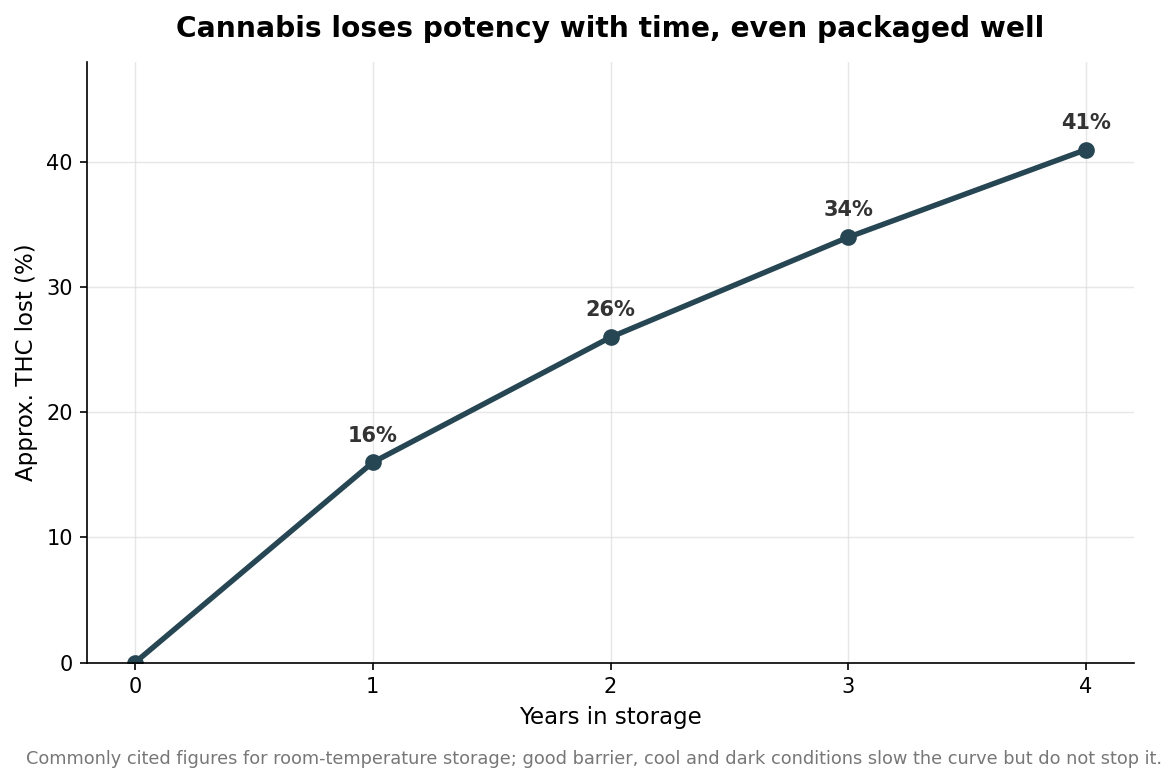
    Line chart of approximate THC lost over four years of storage: 16% at one year, 26% at two, 34% at three, 41% at four
    Commonly cited potency loss over time at room temperature; good packaging slows this curve but cannot stop it.

    Building a package that actually preserves

    Preservation is a system, and the pieces reinforce each other. A high-barrier, opaque film handles light and slows oxygen and moisture exchange; an airtight, resealable closure protects that barrier through repeated use; a correctly rated humidity pack holds the flower in its 55-to-65-percent comfort zone; and a package sized close to the fill keeps trapped oxygen to a minimum. Leave any one of those out and the others work harder for less result, because the weakest link sets the pace of decline.

    None of this competes with compliance or branding; it sits underneath them. A child-resistant, correctly labeled, beautifully printed bag that still lets in light and air will disappoint the customer who opens it three weeks later. Specify the package to protect the product first, then make it compliant and make it beautiful, and the flower a customer opens will smell and perform the way it did the day it was sealed.
  • Mylar Bag Sizes and Barrier Specs: A Deep-Dive for Flower Brands

    Mylar Bag Sizes and Barrier Specs: A Deep-Dive for Flower Brands

    Every flower brand ends up buying mylar bags, and most buyers pick them by eyeballing a size chart and choosing a finish. That works until an eighth rattles around loose in an oversized bag, a batch loses its nose in three weeks, or a compliance officer asks what standard your child-resistant zipper actually meets. The specs on a mylar bag are few, but each one does real work. This is what they mean and how to choose them deliberately.

    “Mylar” is a laminate, not a material

    The bag on your shelf is a three-layer sandwich. A typical construction is an outer PET (polyester) layer of about 12 microns that carries the print and gives the bag its snap, a middle vacuum-metallized PET layer — PET coated with a few hundred angstroms of aluminum — that does the light and oxygen blocking, and an inner polyethylene layer of roughly 60 to 80 microns that heat-seals shut. “Mylar” is technically a trade name for the PET film, but in cannabis packaging it has come to mean this whole metallized laminate. The practical takeaway: the barrier comes from the metallization and the laminate quality, not from thickness alone, so a well-made 4 mil bag can outperform a cheap thick one.

    The size chart, translated to flower

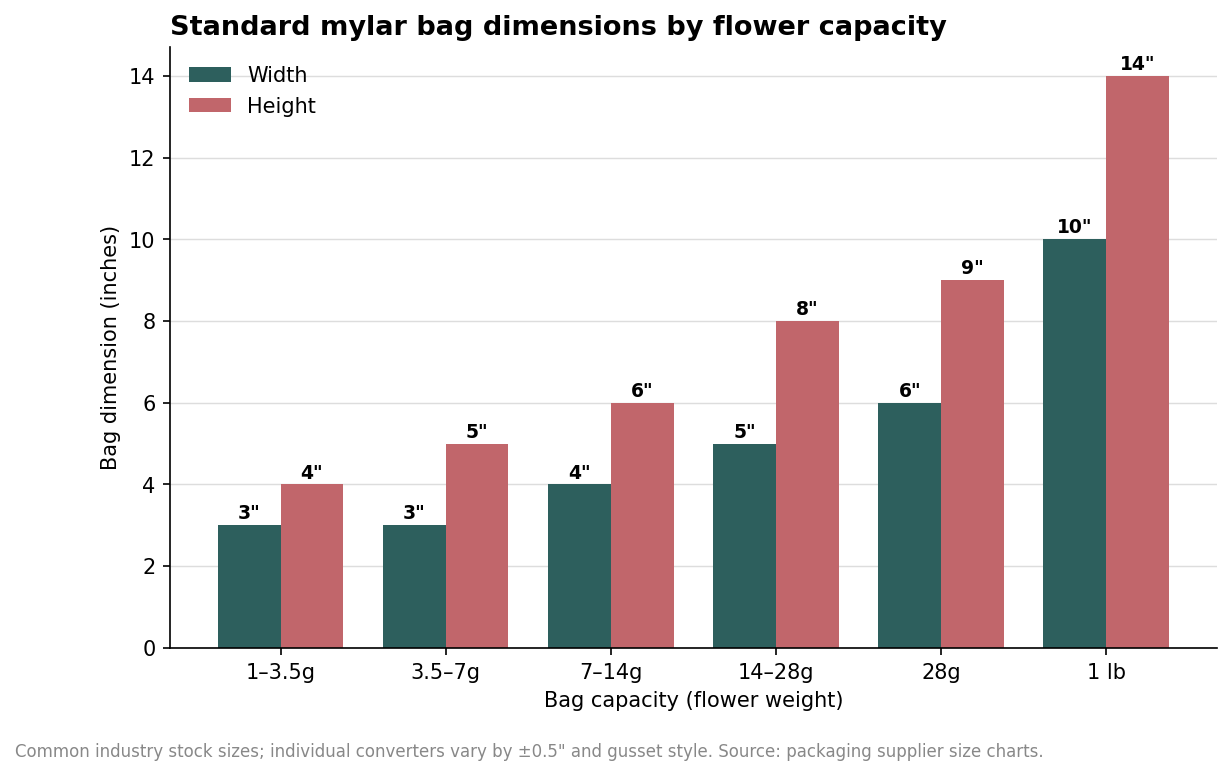
    Stock sizes track purchase weights. For 1g samples and promos through 3.5g eighths, the common bag is about 3 by 4 inches; a 3 by 5 inch bag covers eighths with more headroom and 7g quarters; 4 by 6 inches handles quarters through 14g halves; 5 by 8 inches suits halves and 28g ounces; a 6 by 9 inch bag gives an ounce generous room; and pound bags run around 10 by 14 inches for back-of-house and wholesale transfer. The eighth is the volume king for most retail brands, which is why 3 by 5 inch bags are usually the first size worth printing in quantity.

    Grouped bar chart of standard mylar bag width and height in inches for capacities from 1 gram to 1 pound
    Stock mylar bag dimensions step up with purchase weight; the 3-by-5-inch eighth bag is the workhorse for most retail flower brands.

    Two sizing habits save money. First, size to the puffiness of your cultivar: fluffy, larded-out flower needs a size up from dense indoor at the same weight, and a bag that needs force to close will eventually fail at the zipper. Second, resist the urge to stock every size in custom print. Most brands do fine printing eighth and ounce bags and using labeled stock bags for the low-volume sizes in between.

    Barrier numbers that actually matter

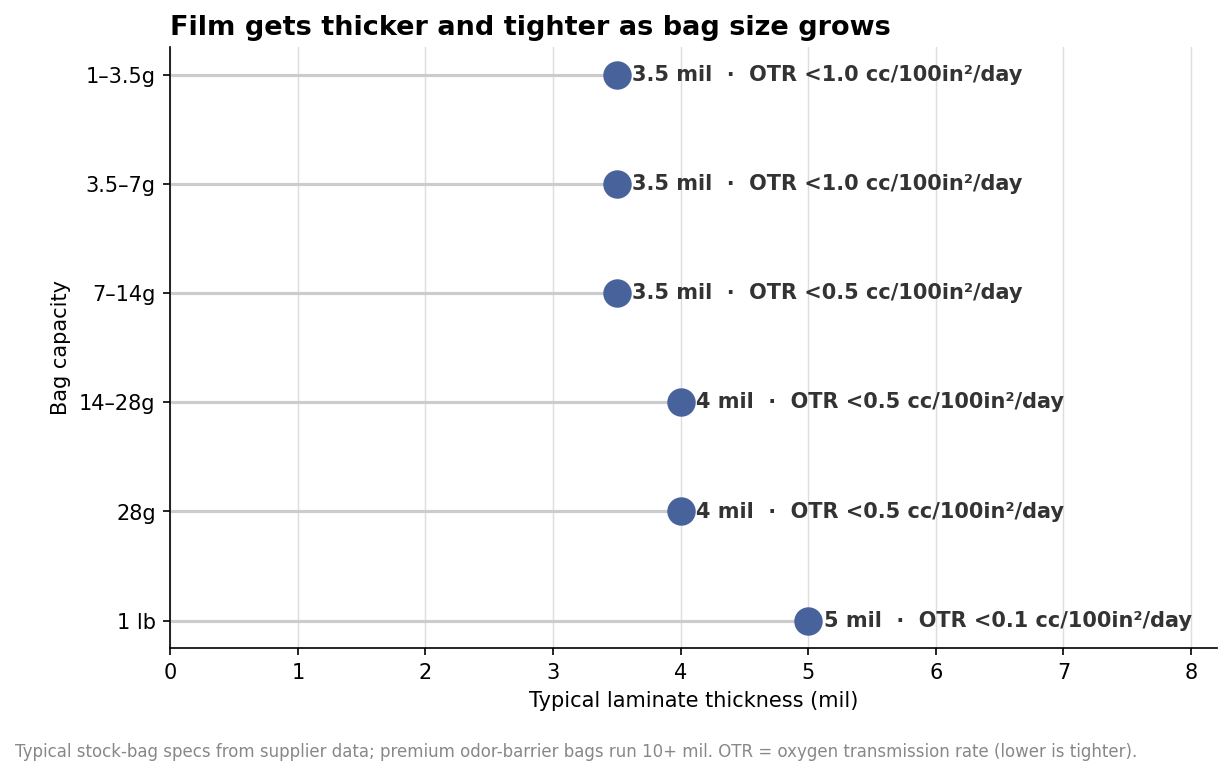
    Thickness is quoted in mils — thousandths of an inch — and stock bags typically run 3.5 mil in the small sizes, about 4 mil in the mid sizes, and around 5 mil at a pound. Thicker film means better puncture resistance and a stiffer, more premium hand feel, and premium odor-barrier bags push past 10 mil.

    The number fewer buyers check is OTR, the oxygen transmission rate, quoted in cubic centimeters of oxygen passing through 100 square inches of film per day. Typical stock bags spec under 1.0 in small sizes and under 0.5 in mid sizes, while high-barrier pound bags run under 0.1, and top-tier odor-barrier laminates advertise figures far below that. Oxygen is what degrades THC to CBN and flattens terpene profiles, so if shelf life is your problem, ask your converter for the OTR spec before you ask for a thicker bag. Moisture transmission (MVTR) matters too — typical specs run from about 0.5 down to 0.1 grams per square meter per day as bags get more serious — though most brands manage moisture inside the bag with a two-way humidity pack anyway.

    Dot plot showing typical mylar laminate thickness in mils and oxygen transmission rate tiers by bag capacity
    Larger stock bags use thicker film and tighter oxygen barriers; premium odor-barrier laminates exceed 10 mil.

    Child resistance and opacity are not optional

    Adult-use states require child-resistant packaging, and for mylar that means a certified CR zipper tested to the federal protocol in 16 CFR 1700.20 — the standard requiring that the large majority of young children in a test panel cannot open the package. Buy bags with test certification on file, not bags described as “CR-style,” because the paperwork is what an auditor asks for. Many states also require opaque exit packaging, and several restrict imagery that appeals to minors, so a clear-front bag that shows off the flower may be legal in one market and a violation in the next. If you sell across state lines of any kind — multi-state operations, licensing deals — spec the strictest market you serve and use one bag everywhere; it is cheaper than running separate SKUs per state.

    Print method sets your minimums

    Custom-printed mylar comes off two very different processes. Digital printing has no plates or cylinders, which makes it the right call below roughly 10,000 units per design — short runs, seasonal drops, and brands that revise artwork often. Rotogravure printing engraves a cylinder per color and typically starts at minimums around 10,000 units per design, in exchange for sharper detail, tighter color consistency, and a lower unit price at volume. A common progression is to launch digital, prove the SKU, then move your one or two highest-velocity sizes to gravure once you can commit to five figures of units. Whichever route you take, plan for overseas gravure lead times measured in weeks, not days, and order your next run when the current one is half gone — indicative timing, but running a dispensary drop on unprinted backup bags because the reorder is on the water is the most common self-inflicted wound in this category.

    When you request a quote, send five specs: bag size and gusset style, laminate thickness in mils, OTR if shelf life matters to you, certified CR zipper with documentation, and finish plus print method with your expected annual units per SKU. A converter can turn that into an accurate price in one pass — and you will be comparing suppliers on the numbers that determine how your flower actually holds up.

  • Hello world!

    Call or Text us: (929) 605-4397

    Welcome to WordPress. This is your first post. Edit or delete it, then start writing!

    GET A QUOTE
  • How to Order Custom Cannabis Packaging: A Checklist — Custom Cannabis Packaging Co.

    Call or Text us: (929) 605-4397
    Home › Blog › Buyer Guides

    How to Order Custom Cannabis Packaging: A Checklist

    June 26, 2026 · Buyer Guides

    Ordering compliant, branded cannabis packaging has a few more moving parts than ordinary packaging, but the process is straightforward once you know the steps.

    1. Choose the format

    Exit bag, tube, vial, jar, concentrate container, or box — driven by your product and price point. Unsure? Tell us the product and we’ll recommend.

    2. Confirm your market’s requirements

    Before design, nail down your state’s rules: child-resistance, opacity, required symbols and warnings, and content fields. This shapes the whole package.

    3. Send artwork and copy

    Vector files are ideal; no print-ready art is fine — send a logo and we’ll build it. Provide the required regulatory copy for your market, or the details we need to lay it out.

    4. Review the mockup

    We return a photo-real mockup showing branding and compliance copy together, usually within one business day. Revise free until it’s right.

    5. Approve and produce

    Approve, and production runs about two to three weeks (boxes slightly longer). We keep your files for fast, matching reorders.

    StepWhat you provide
    FormatProduct type and price tier
    ComplianceYour market’s current rules
    ArtworkVector files or a logo to build from
    ApprovalSign-off on the mockup

    Start with a quote and we’ll walk you through each step — including placing compliance copy cleanly.

    Key takeawayOrdering cannabis packaging is five steps: choose the format, confirm your market’s rules, send artwork and required copy, approve a free mockup, then produce. Compliance requirements shape the whole package, so nail them down first.

    Ready to start? Get a custom quote for your cannabis packaging, learn more about how we work, or browse more guides.

    Get a quote for custom cannabis packaging.

    Free mockup and bulk pricing within one business day.

    Get a Quote
  • Sustainable Cannabis Packaging: Realistic Options Today — Custom Cannabis Packaging Co.

    Call or Text us: (929) 605-4397
    Home › Blog › Sustainability

    Sustainable Cannabis Packaging: Realistic Options Today

    June 22, 2026 · Sustainability

    Cannabis regulation drives a lot of single-use packaging, and customers increasingly notice. There’s no perfect answer yet, but there are meaningfully greener choices. Here’s an honest look.

    Recyclable materials

    Polypropylene vials and tubes are widely recyclable, and glass jars are endlessly recyclable. Choosing mono-material components (avoiding mixed-material laminates where possible) improves the odds a package actually gets recycled.

    Alternative and recycled content

    Hemp-based and ocean-bound-plastic tubes and jars exist and are improving, as are components with post-consumer recycled content. They cost more but tell a genuine sustainability story.

    Right-size to cut waste

    The simplest win is using less. A properly sized container and a carton without excess air reduce material per unit. Reclosable packaging also encourages reuse.

    ApproachTrade-off
    Recyclable PP / glassWidely available; recycling depends on local streams
    Hemp / ocean plasticBetter story; higher cost
    PCR contentLess virgin plastic; supply varies
    Right-sizingFree win; requires design discipline

    Compliance still comes first — a package must be certified and legal before it’s green. Within those limits, we’ll recommend the most sustainable option that fits your market and product.

    Key takeawayRecyclable glass and PP, hemp and recycled-content components, and simple right-sizing are the realistic sustainability levers in cannabis packaging today — always within compliance requirements, which come first.

    Ready to start? Get a custom quote for your cannabis packaging, learn more about how we work, or browse more guides.

    Get a quote for custom cannabis packaging.

    Free mockup and bulk pricing within one business day.

    Get a Quote
  • Child-Resistant Closures, Explained by Format — Custom Cannabis Packaging Co.

    Call or Text us: (929) 605-4397
    Home › Blog › Compliance

    Child-Resistant Closures, Explained by Format

    June 18, 2026 · Compliance

    “Child-resistant” isn’t one thing — it’s a family of certified closures, each suited to a different package. Here’s how the common ones work.

    Press-and-slide zipper (bags)

    Used on mylar exit bags. You press two points and slide simultaneously — a motion difficult for small hands. The bag reseals and stays child-resistant after opening.

    Pop-top (tubes and vials)

    Press the base while pulling the cap; the top pops off, then snaps back airtight. Ubiquitous on vials and pre-roll tubes because it’s cheap, reliable, and familiar.

    Squeeze-top (tubes)

    Squeeze the tube at two marked points to release the cap. A premium alternative to the pop-top for pre-roll tubes.

    CR lid (jars)

    A push-and-turn or squeeze-and-turn lid on glass jars, combining a certified close with a premium format. Foam liners and induction seals add tamper evidence.

    ClosurePackageNote
    Press-and-slideMylar bagsReclosable, smell-proof
    Pop-topVials, tubesCheapest, familiar
    Squeeze-topTubesPremium feel
    CR lidGlass jarsPremium + tamper seal

    All of these are certified to the recognized standards. Which you choose follows the package and the price point — we’ll spec the right one for your product.

    Key takeawayCertified child-resistance comes in several forms — press-and-slide zippers, pop-tops, squeeze-tops, and CR lids. The right closure follows the package format and price point; all are tested to the same standards.

    Ready to start? Get a custom quote for your cannabis packaging, learn more about how we work, or browse more guides.

    Get a quote for custom cannabis packaging.

    Free mockup and bulk pricing within one business day.

    Get a Quote
  • Packaging Concentrates: Non-Stick, Airtight, and Compliant — Custom Cannabis Packaging Co.

    Call or Text us: (929) 605-4397
    Home › Blog › Concentrates

    Packaging Concentrates: Non-Stick, Airtight, and Compliant

    June 14, 2026 · Concentrates

    Concentrates punish bad packaging. They’re sticky, high-value, and sensitive to light and air, so the container is part of the product experience. Here’s how to get it right.

    Non-stick is non-negotiable

    Stickier extracts — badder, sauce, fresh rosin — cling to ordinary surfaces and are wasted on the lid. A silicone-lined or fully silicone container releases them cleanly. Firmer concentrates do well in coated or high-quality glass, which looks more premium.

    Airtight and light-protective

    Air and light degrade terpenes and cannabinoids. An airtight seal keeps the concentrate fresh, and a tinted or opaque container (or an outer box) protects from light. A shrink band adds tamper evidence.

    Size to the fill

    Concentrates are sold in small amounts — half-gram to two grams — so the container should fit precisely. Five- to fifteen-milliliter jars cover the range without wasted headspace.

    ConcentrateBest container
    Firm (shatter, crumble)Coated / premium glass
    Sticky (badder, sauce, rosin)Silicone-lined jar
    Premium / heroGlass in a printed box

    All behind a certified child-resistant lid, with your branding on the jar or lid. We’ll help you match the container to your extract.

    Key takeawayConcentrate packaging must be non-stick, airtight, light-protective, and sized to small fills. Use silicone for sticky extracts and premium glass for firmer ones, always with a certified child-resistant close.

    Ready to start? Get a custom quote for your cannabis packaging, learn more about how we work, or browse more guides.

    Get a quote for custom cannabis packaging.

    Free mockup and bulk pricing within one business day.

    Get a Quote
  • How to Brand Pre-Rolls: Tubes, Labels, and Multi-Packs — Custom Cannabis Packaging Co.

    Call or Text us: (929) 605-4397
    Home › Blog › Pre-Rolls

    How to Brand Pre-Rolls: Tubes, Labels, and Multi-Packs

    June 10, 2026 · Pre-Rolls

    Pre-rolls are one of the fastest-growing cannabis categories and one of the most commoditized. Packaging is the main lever brands have to stand out. Here’s how to think about it.

    Start with the right tube

    A child-resistant tube protects the cone and gives you a branded surface. Match the tube to the cone: 78 mm for slims, 98–109 mm for standard, longer for king and multi-cone formats. Opaque and tinted tubes protect from light; clear shows the roll.

    Label vs. shrink sleeve vs. direct print

    A pressure-sensitive label is flexible and cheap to update. A shrink sleeve wraps the tube edge to edge for a fully printed look. Direct print is clean and permanent. For most brands, labels win on flexibility; sleeves win on premium shelf presence.

    Multi-packs raise order value

    Two-, five-, and seven-count tubes and cartons turn a single-unit impulse buy into a higher-value purchase and merchandise as a set. They’re also more efficient to label and stock.

    DecisionOptions
    Tube size78–116 mm to match the cone
    MaterialClear, opaque, frosted, tinted
    DecorationLabel, shrink sleeve, or direct print
    FormatSingle or 2 / 5 / 7-count multi-pack

    Add a foil freshness seal for a quality cue and you’ve turned a commodity into a brand. We’ll mock up your pre-roll packaging so you can compare formats.

    Key takeawayMatch the tube to the cone, pick labels for flexibility or shrink sleeves for premium presence, and use multi-packs to raise order value. Packaging is how a commodity pre-roll becomes a brand.

    Ready to start? Get a custom quote for your cannabis packaging, learn more about how we work, or browse more guides.

    Get a quote for custom cannabis packaging.

    Free mockup and bulk pricing within one business day.

    Get a Quote
  • Exit Bags vs. Jars vs. Tubes: Choosing a Flower Format — Custom Cannabis Packaging Co.

    Call or Text us: (929) 605-4397
    Home › Blog › Buyer Guides

    Exit Bags vs. Jars vs. Tubes: Choosing a Flower Format

    June 6, 2026 · Buyer Guides

    When you package flower, you’re choosing between three dominant formats: flexible mylar exit bags, glass jars, and pop-top vials. Each hits a different point on cost, protection, and premium feel. Here’s how to pick.

    Mylar exit bags: flexible and affordable

    The everyday standard. Fully printable, opaque, smell-proof, and inexpensive per unit, exit bags suit pre-packs, value and mid-tier flower, and any SKU where cost and branding flexibility matter most. They ship flat and light.

    Glass jars: premium and protective

    The flagship format. Glass protects terpenes and aroma, feels substantial, and signals top-shelf. It costs the most per unit and adds shipping weight, so it’s reserved for hero SKUs and premium lines where perceived value justifies the price.

    Pop-top vials: compact and low-cost

    The gram staple. Small, certified, and the cheapest certified container, vials are ideal for single grams, samples, and value packaging where per-unit cost is everything.

    FormatCostFeelBest for
    Exit bagLowModernPre-packs, mid-tier
    Glass jarHighPremiumTop-shelf, flagship
    Pop-top vialLowestUtilityGrams, samples

    Many brands use all three — vials for grams, bags for the core line, jars for the flagship. We can produce a coordinated set in matching artwork.

    Key takeawayExit bags are the affordable, flexible standard; glass jars are the premium flagship; pop-top vials are the low-cost gram staple. Most brands use all three, matched in one artwork system.

    Ready to start? Get a custom quote for your cannabis packaging, learn more about how we work, or browse more guides.

    Get a quote for custom cannabis packaging.

    Free mockup and bulk pricing within one business day.

    Get a Quote
  • Cannabis Packaging Compliance: The Basics Every Brand Should Know — Custom Cannabis Packaging Co.

    Call or Text us: (929) 605-4397
    Home › Blog › Compliance

    Cannabis Packaging Compliance: The Basics Every Brand Should Know

    June 2, 2026 · Compliance

    Cannabis packaging sits at the intersection of branding and regulation, and the regulatory side trips up more brands than any other. This is a plain-language overview of the concepts that matter. Because rules vary by state and change frequently, treat this as background and confirm your specific market’s current requirements with a compliance advisor before you print.

    Child-resistance is the baseline

    Nearly every market requires that packaging containing cannabis be child-resistant — tested so young children can’t easily open it while adults can. In practice that means certified closures: press-and-slide zippers on bags, pop-tops and squeeze-tops on tubes and vials, and CR lids on jars. Some markets require the package to remain child-resistant after opening (reclosable CR).

    Opacity and light protection

    Many states require packaging to be opaque so the product isn’t visible, and opacity also protects flower from light degradation. This is why opaque foil bags and amber glass are so common.

    Labeling and required copy

    Every market mandates specific label elements — universal symbols, warning statements, THC/CBD content, net weight, lot and date, and often a scannable code. The exact list and formatting differ by state, which is why a template rarely works across markets.

    RequirementTypical form
    Child-resistanceCertified closure (ASTM / 16 CFR 1700.20)
    OpacityOpaque bag or amber/tinted container
    Symbols & warningsState universal symbol + warning text
    Content & lotTHC/CBD, net weight, lot, date fields

    How we help

    We build to certified closures and our designers place required copy cleanly alongside your branding — but we’re your packaging partner, not your compliance authority. Always verify your market’s current rules before production.

    Key takeawayChild-resistance, opacity, and market-specific labeling are the pillars of cannabis packaging compliance. Rules vary by state and change often, so confirm your market’s current requirements before you print.

    Ready to start? Get a custom quote for your cannabis packaging, learn more about how we work, or browse more guides.

    Get a quote for custom cannabis packaging.

    Free mockup and bulk pricing within one business day.

    Get a Quote