Every flower brand ends up buying mylar bags, and most buyers pick them by eyeballing a size chart and choosing a finish. That works until an eighth rattles around loose in an oversized bag, a batch loses its nose in three weeks, or a compliance officer asks what standard your child-resistant zipper actually meets. The specs on a mylar bag are few, but each one does real work. This is what they mean and how to choose them deliberately.
“Mylar” is a laminate, not a material
The bag on your shelf is a three-layer sandwich. A typical construction is an outer PET (polyester) layer of about 12 microns that carries the print and gives the bag its snap, a middle vacuum-metallized PET layer — PET coated with a few hundred angstroms of aluminum — that does the light and oxygen blocking, and an inner polyethylene layer of roughly 60 to 80 microns that heat-seals shut. “Mylar” is technically a trade name for the PET film, but in cannabis packaging it has come to mean this whole metallized laminate. The practical takeaway: the barrier comes from the metallization and the laminate quality, not from thickness alone, so a well-made 4 mil bag can outperform a cheap thick one.
The size chart, translated to flower
Stock sizes track purchase weights. For 1g samples and promos through 3.5g eighths, the common bag is about 3 by 4 inches; a 3 by 5 inch bag covers eighths with more headroom and 7g quarters; 4 by 6 inches handles quarters through 14g halves; 5 by 8 inches suits halves and 28g ounces; a 6 by 9 inch bag gives an ounce generous room; and pound bags run around 10 by 14 inches for back-of-house and wholesale transfer. The eighth is the volume king for most retail brands, which is why 3 by 5 inch bags are usually the first size worth printing in quantity.
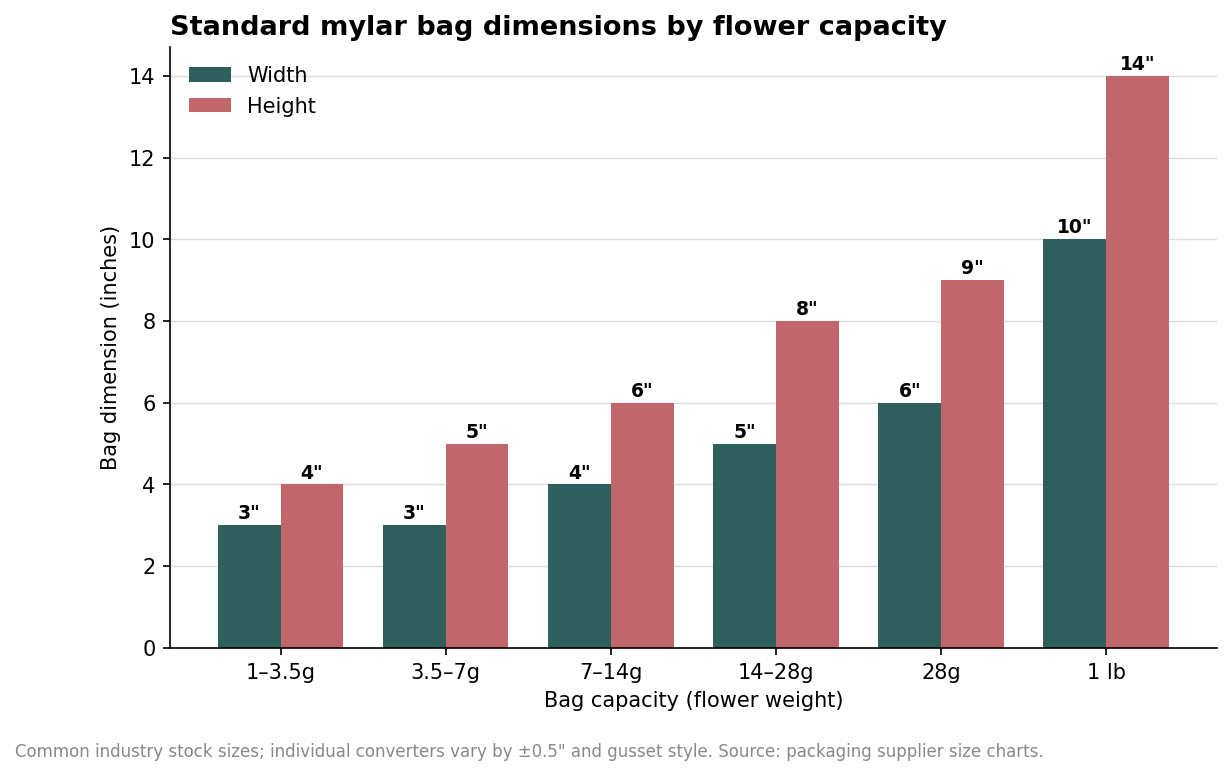
Two sizing habits save money. First, size to the puffiness of your cultivar: fluffy, larded-out flower needs a size up from dense indoor at the same weight, and a bag that needs force to close will eventually fail at the zipper. Second, resist the urge to stock every size in custom print. Most brands do fine printing eighth and ounce bags and using labeled stock bags for the low-volume sizes in between.
Barrier numbers that actually matter
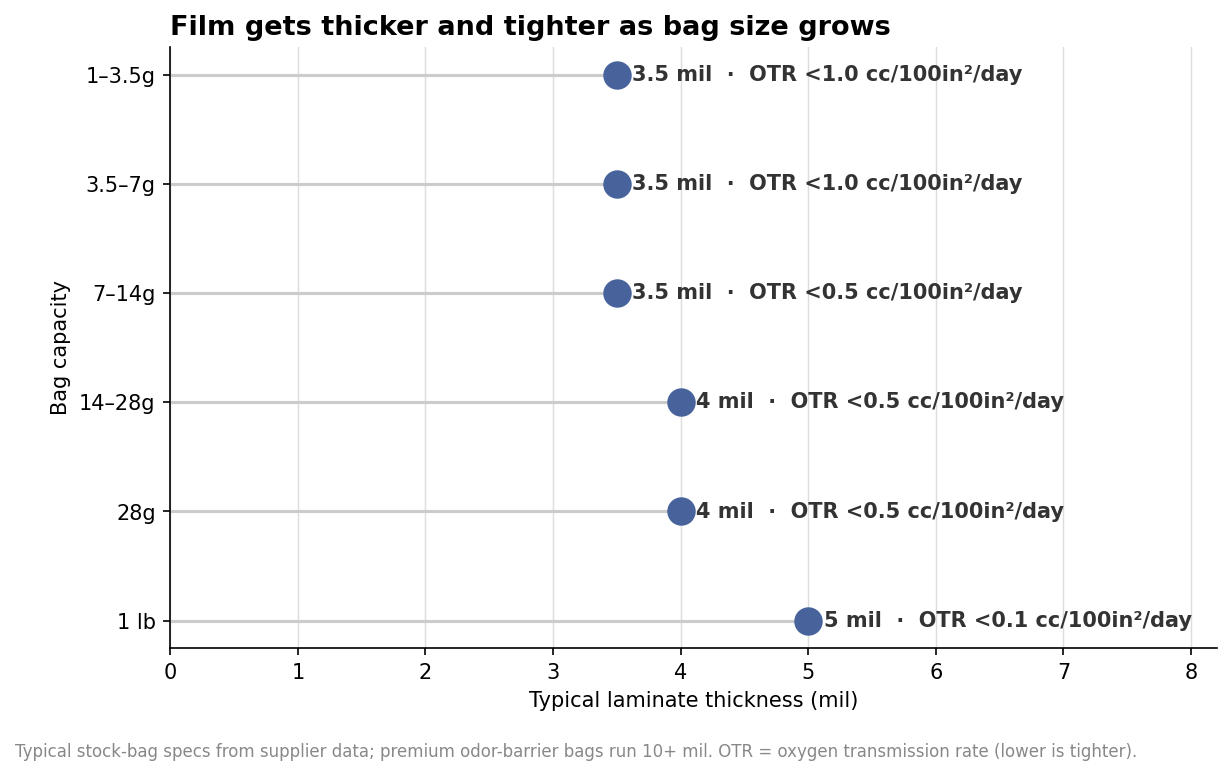
Thickness is quoted in mils — thousandths of an inch — and stock bags typically run 3.5 mil in the small sizes, about 4 mil in the mid sizes, and around 5 mil at a pound. Thicker film means better puncture resistance and a stiffer, more premium hand feel, and premium odor-barrier bags push past 10 mil.
The number fewer buyers check is OTR, the oxygen transmission rate, quoted in cubic centimeters of oxygen passing through 100 square inches of film per day. Typical stock bags spec under 1.0 in small sizes and under 0.5 in mid sizes, while high-barrier pound bags run under 0.1, and top-tier odor-barrier laminates advertise figures far below that. Oxygen is what degrades THC to CBN and flattens terpene profiles, so if shelf life is your problem, ask your converter for the OTR spec before you ask for a thicker bag. Moisture transmission (MVTR) matters too — typical specs run from about 0.5 down to 0.1 grams per square meter per day as bags get more serious — though most brands manage moisture inside the bag with a two-way humidity pack anyway.
Child resistance and opacity are not optional
Adult-use states require child-resistant packaging, and for mylar that means a certified CR zipper tested to the federal protocol in 16 CFR 1700.20 — the standard requiring that the large majority of young children in a test panel cannot open the package. Buy bags with test certification on file, not bags described as “CR-style,” because the paperwork is what an auditor asks for. Many states also require opaque exit packaging, and several restrict imagery that appeals to minors, so a clear-front bag that shows off the flower may be legal in one market and a violation in the next. If you sell across state lines of any kind — multi-state operations, licensing deals — spec the strictest market you serve and use one bag everywhere; it is cheaper than running separate SKUs per state.
Print method sets your minimums
Custom-printed mylar comes off two very different processes. Digital printing has no plates or cylinders, which makes it the right call below roughly 10,000 units per design — short runs, seasonal drops, and brands that revise artwork often. Rotogravure printing engraves a cylinder per color and typically starts at minimums around 10,000 units per design, in exchange for sharper detail, tighter color consistency, and a lower unit price at volume. A common progression is to launch digital, prove the SKU, then move your one or two highest-velocity sizes to gravure once you can commit to five figures of units. Whichever route you take, plan for overseas gravure lead times measured in weeks, not days, and order your next run when the current one is half gone — indicative timing, but running a dispensary drop on unprinted backup bags because the reorder is on the water is the most common self-inflicted wound in this category.
When you request a quote, send five specs: bag size and gusset style, laminate thickness in mils, OTR if shelf life matters to you, certified CR zipper with documentation, and finish plus print method with your expected annual units per SKU. A converter can turn that into an accurate price in one pass — and you will be comparing suppliers on the numbers that determine how your flower actually holds up.
Leave a Reply